Duration 18′ –
Clearing is a short film and immersive installation situated at the intersection of ritual practice and embodied experience. Unfolding as a single, continuous take, the work privileges duration, presence, and attention over narrative progression or symbolic explanation. Time is not compressed or edited for effect; instead, it is allowed to accumulate, inviting a mode of reception grounded in bodily attunement rather than interpretation.
The installation employs multi-screen projection and spatialised sound to create a perceptual immersion. Drawing on theories of presence and involvement in media psychology, Clearing works toward a condition of non-mediation, not through technological spectacle, but through sustained sensory engagement. The aim is not to overwhelm, but to facilitate a state of co-presence in which the viewer’s phenomenal body becomes implicated in the event.
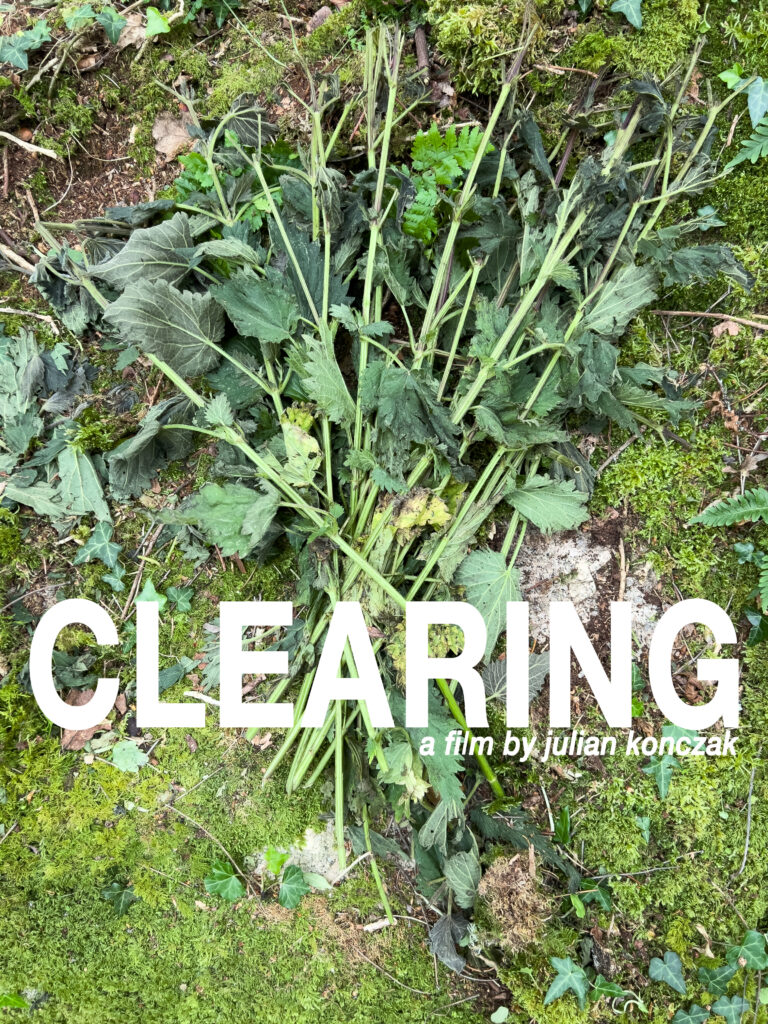
At the centre of the work is the practice of urtication – the controlled striking of the skin with stinging nettles, a technique historically associated with folk medicine, ritual purification, and altered states of consciousness. Nettles have been documented since antiquity as agents of stimulation and healing, their effects understood as both physiological and psychological. In Clearing, pain is approached not as pathology or provocation, but as a threshold experience: a means of reorienting attention and disrupting habitual modes of perception.
The work is informed by depth psychology and contemporary re-evaluations of consensual power exchange practices, particularly those that frame pain as an integrative rather than disintegrative force. Within this context, pain functions as a structuring agent, capable of producing flow states, temporal distortion, and a temporary loosening of egoic control. These dynamics resonate with ritual traditions in which intensity is used to access liminal or transformative states, as well as with psychological models that emphasise embodiment, consent, and containment.
Clearing also draws on traditions of ritual and magical cinema, where film is conceived not simply as representation but as an act of invocation. Influenced by physical theatre and experimental film practices that collapse the distinction between semiotic and phenomenal bodies, the work seeks to operate as an event rather than an image — a site where meaning emerges through sensation, duration, and shared presence.
Positioned against a contemporary media landscape characterised by fragmentation and distraction, Clearing proposes a re-wilding of the moving image. It asks how cinema might function if attention were treated as its primary material, and if immersive technologies were used not to simulate spectacle, but to support altered states of awareness rooted in the body.
Clearing does not resolve its tensions. Instead, it sustains them -between care and intensity, documentation and ritual, pleasure and discomfort – offering a space in which these forces may be encountered without foreclosure. The work invites viewers into a clearing: a temporary suspension of habitual perception, where something felt but unnamed can arise.
Flagellation in the wilderness – set in a rural idyll and shot in one take on multiple cameras, the film documents the ritual use of urtication with stinging nettles to induce cathartic altered states. The work is designed to communicate direct sensation to the audience; it is an invitation to experience physical pain and discomfort through immersive image and sound. The film is an exploration of the potential therapeutic effects of kink.