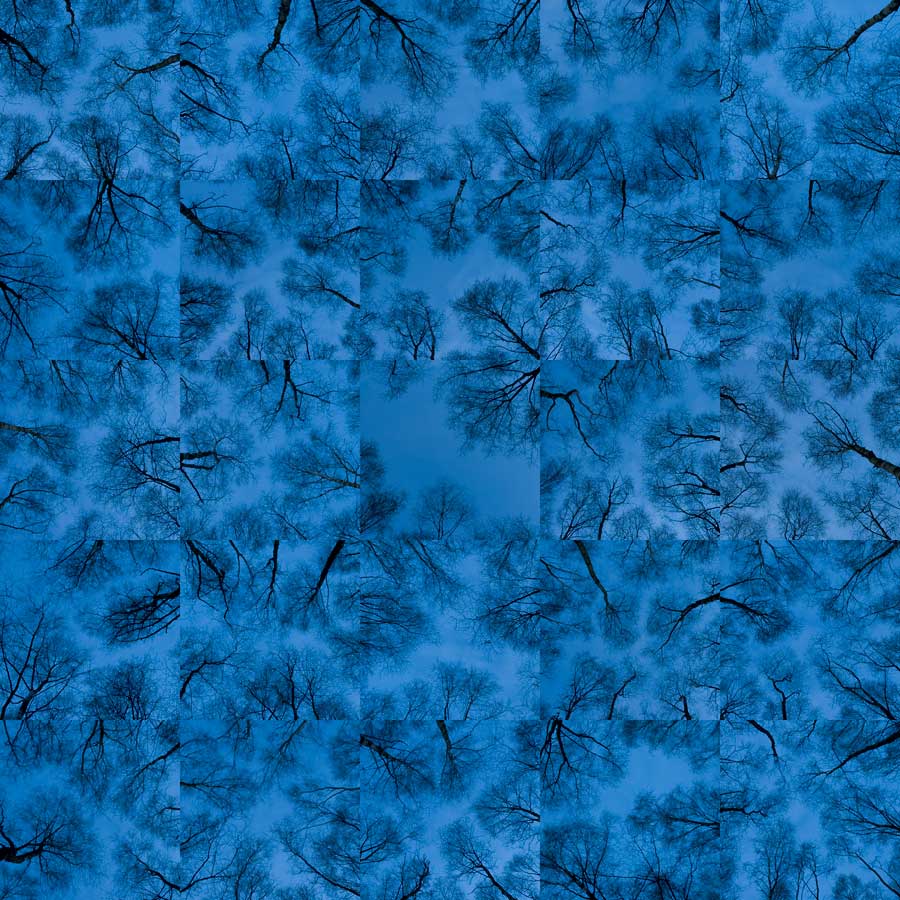
25 – Birth and Decay emerged when visual culture was undergoing a profound shift. Around 2005, the predominant medium of distribution was rapidly shifting from print to screens, bringing with it a fundamental reconfiguration of how images were perceived. Print had reached a point where high-quality colour reproduction could offer the pleasure of continuous tone and near-verisimilitude. But digital media introduced a different type of visual experience: the era of the thumbnail.
Instead of contemplation through a single crafted image, the screen offered the thrill of abundance—grids, galleries, and the promise of endless variation. What is now ubiquitous in social media and online shopping was then an emerging visual landscape, and the systematic juxtaposition of thumbnails became a key point of inspiration for a series of works I developed.
Coming from a moving-image background, the format of 25 images arranged in a grid felt ideal. Not only did it echo one second of film, but it also allowed individual frames to merge into a single visual field—becoming, in effect, a new image. Digital cameras were becoming widely accessible, and with them came an awareness that any photograph was just one iteration among countless others: one moment in a chain of images taken before and after, multiplied even further by the rise of camera phones. Many of these grids were therefore built by photographing the same subject repeatedly—shifting angle, timing, or perspective.
This particular work centred on the forest, a site that had long been a source of creative inspiration for me. I was drawn to the way seasonal cycles sweep across a landscape, transforming it with a grand but predictable rhythm. Within weeks, birch trees burst into bright green leaves, only to move on to the next phase, and the next. 25 – Birth and Decay sought to distil these transformations into a visual and temporal field.
The piece was created using Flash, whose interactive possibilities were especially exciting at the time. It enabled viewers to navigate the work as if through time, exploring an abstracted representation of natural cycles in a tactile way. The interface had a playful dimension: moving the mouse “painted” the next layer of the cycle into view, while clicking jumped the entire grid forward to the next stage. It was an experiment in the haptics of early interactive media, anticipating the gestures and sensory expectations that would soon become familiar in a touchscreen world.
Images from other elements of the 25 project are viewable here.
The work toured internationally and featured in numerous digital art festivals.
Below is a screen recording of the interactive work. It is a linear representation of the project, as the Flash software that enabled interactivity is no longer supported by modern browsers.